School Avoidance Expert Dr. Albano: How To Help Your Child’s Anxiety

In this Psychcast interview from 2020, Dr. Albano discusses treating kids with anxiety disorders.  

MDedge is for physicians, and health care professionals providing medical news trusted and credible sources. Dr. Lorenzo Norris, MD, is the host of the MDedge Psychcast, editor in chief of MDedge Psychiatry, and assistant professor of psychiatry and behavioral sciences at George Washington University,

Dr. Albano’s interview starts around the 7-minute mark and ends at 30 minutes.

School avoidance families will find value as Dr. Albano addresses escape as avoidance and how natural parent instincts lead to accommodations that enable our kid’s avoidance. Her guidance and insight are helpful for us to understand so we can work on correcting this pattern.

The doctor highlights the value of exposure and comments on SSRI Antidepressants.

Being a former member of the school avoidance parent club, I see how this truth can sting for a couple of reasons.

1. In theory, this makes total sense, but in reality, it feels callously tough to counter when you have a screaming, crying kid hiding under their covers.

2. It can make you feel like a lousy parent hearing what you should have done.

But, Dr. Albano says that not giving into accommodations goes against our parental instincts. It is human nature to soothe our kids and feel pained watching them feel pain. So, as a parent, you are not a fault!

She reiterates this around the 27-minute mark when Dr. Norris asks Dr. Albano what advice she would give to mental health providers helping families with their kid’s anxiety disorders.

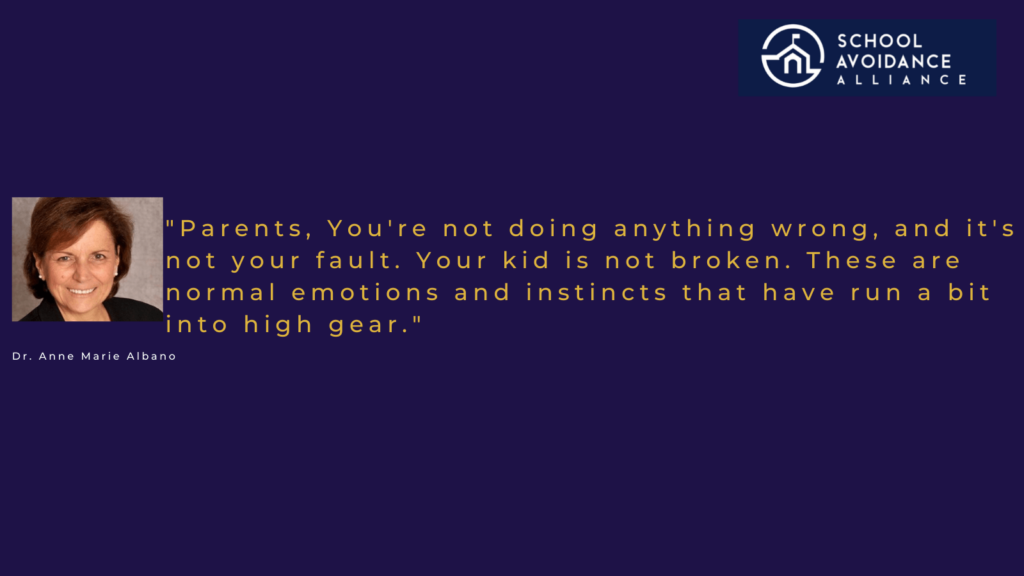
‘Parents, You’re not doing anything wrong, and it’s not your fault. Your kid is not broken. These are normal emotions and instincts that have run a bit into high gear.

You may also like

More Than a Tardy Slip: Georgia’s SB 123 Marks a Turning Point in School Attendance and Why School Avoidance Training Is the Missing Link

More Than a Tardy Slip: Georgia’s SB 123 Marks a Turning Point in School Attendance and Why School Avoidance Training Is the Missing Link

Georgia’s new attendance law, SB 123, is here, and it’s a major shift. No longer can schools expel students solely for absenteeism. Instead, the law, effective July 1, 2025, mandates a deeper look at the root causes of why students are missing school.

This article explores why SB 123 is a critical opportunity, not a compliance burden. It’s a chance to move from punishment to empathy. But to succeed, schools must address one critical, often-overlooked piece of the puzzle: “school avoidance.” Discover why training staff to recognize and support emotionally-based absenteeism is the key to unlocking the true, positive potential of this new law.

How to understand and manage school attendance, truancy, and the 90% rule when your child has health-related absences. Quick Summary / Hook: For Texas families of children with disabilities or chronic health needs, frequent school absences are often unavoidable. However, Texas law has strict rules about attendance, including the 90% attendance rule and truancy laws that may impact class credit and graduation. This guide explains those rules in depth and offers practical strategies for staying in compliance, protecting your child’s rights, and building strong partnerships with your child’s school.

Navigating Texas Attendance Laws for Students with Disabilities and Health Needs

For Texas families of children with disabilities or chronic health needs, frequent school absences are often unavoidable. However, Texas law has strict rules about attendance, including the 90% attendance rule and truancy laws that may impact class credit and graduation. This guide explains those rules in depth and offers practical strategies for staying in compliance, protecting your child’s rights, and building strong partnerships with your child’s school.

Truancy laws in Texas have evolved significantly over the past decade. Once criminalized, student absences are now handled through civil procedures and school-based interventions. But that doesn’t mean the consequences are light—or the system easy to navigate. If your child is struggling with school attendance due to anxiety, disability, or external stressors, it’s critical to understand how truancy laws in Texas operate, what schools are allowed to do, and how to respond before things escalate to court. This guide offers a thorough, family-centered explanation of Texas’s truancy process and how to avoid common pitfalls.

Understanding Truancy Laws in Texas: A Parent’s Guide to Rights, Risks, and Remedies

Truancy laws in Texas have evolved significantly over the past decade. Once criminalized, student absences are now handled through civil procedures and school-based interventions. But that doesn’t mean the consequences are light—or the system easy to navigate. If your child is struggling with school attendance due to anxiety, disability, or external stressors, it’s critical to understand how truancy laws in Texas operate, what schools are allowed to do, and how to respond before things escalate to court. This guide offers a thorough, family-centered explanation of Texas’s truancy process and how to avoid common pitfalls.

Get Help Today with
Exclusive Access to Leading
School Avoidance Experts

Unfortunately only a small percentage of school professionals, therapists, educational advocates and policy makers understand school avoidance best practices. So, you must become the expert to ensure your child is getting:

  • Appropriate mental health treatment
  • School assistance without punitive responses (truancy, failing, grade retention)
  • Educated regardless of their school avoidance
  • A 504 plan or IEP if needed (many school avoidant kids qualify)

The time passing slowly without progress is the worst feeling. It wouldn’t have taken five years of suffering and uncertainty if I had this expert guidance during my son’s school avoidance. We would have saved $29,000 in lawyer fees and $69,000 for private schools.

Providing Information School Avoidance Families Need To Know

This Guide explains; 504 Plans, IEPs, Attendance Policies & More

We Use Cookies

We use cookies to make your experience on this website better.